Sunday, October 16, 2016

Dunbrody Famine Ship and JFK Homestead


This is a post which Elizabeth and Meghann wrote for our academic blog about our trip to Wexford to see the Dunbrody Famine Ship and the JFK Homestead. This blog contains the adventures of Brad, Meghann, Elizabeth, and Eva.


 ~~~~~~~~~~~~~~~~~~~~~~~~~~~~~~~~~~~~~~~~~~~~~~~~~~~~~~~~~~~~~~~~~~~~~~~~~~

So many people during the "Great Hunger" sailed across the sea to the Americas and Canada that this globe has a burning flame within it to show how the Emigrants have created a "flame" around the world.

 In 1847 the potato crop failed entirely. This year was known as black '47. Blight struck the potato plants and when they were dug up from the ground the potatoes crumbled like black ash. For the Irish living in distant rural areas, this was a tragedy. For generations, all the people had ever eaten for all meals of the day was potatoes. They didn't even know about other types of food. Potatoes were all they could grow, so for the poor in the rural areas that was all they had to eat.

For those living in the towns, life tended to be slightly better, and they did not starve because other foods still grew which they could eat.

But as the famine continued for the next several years, the people grew emaciated. When the English decided to do something about it, they imported Native American grain. But it was too little too late, and the Irish didn't know what to do with the grain if they could get it. Soup kitchens were opened in the towns, but they did not help most of the people who needed it most. Those who desperately needed it lived out in the country and were too weak from starvation and disease to make the long, long journey into town for a little soup, which was just flavored water and not very nutritious.

A few centuries before the famine when the English came and pushed the indigenous Irish to the far corners of Ireland, being Catholic was outlawed. This continued through the time of the famine. If you were Catholic, you were not allowed to own land, so your entire family, grandparents through grandchildren and the generations beyond, had to live in a tiny house on small plots of land that was rented. It was common for Catholic families to have over ten children, but most of them never lived to see adulthood. But the Irish had been faithful Catholics for over a thousand years, and they were not going to change because of these difficulties. Rather, they clung to their faith that God would see them through these troubles. Food was offered to them as a bribe to forsake their Catholic faith, and most would not risk their or their children's eternal destination for a bowl of soup.

Since the people were still dying, the English government told the landlords to "give assistance" to their tenants. However, it was easier and cheaper for most of the landlords to get rid of the dying Irish and use the land for grazing livestock. Many got the cheapest ticket they could find and offered it to the Irish. It was a ticket for a ship sailing to the new world, and it was the only way for them to survive so many of them were forced to take it.

These ships were just glorified cargo ships. The living quarters for these Irish passengers were atrocious. The inside of the ship showed what the living quarters for the people traveling on the ships would have looked like.
First class beds
 One family would have to fit on one of these bunk beds. But there were often over ten people in one bed. They also had to store any of their belongings with them on the bed, so they kept their food, pots and anything else with them.

For food, each family was brought up onto the deck of the ship where they had to bake bread over a fire until it was rock hard because it needed to last them until the next time they had a chance to make more. To eat it, they took rainwater, dipped the bread in, to moisten it, crumbled it into a ball and fed it to themselves or their children while the sailors ate fresh fish or salted meat.
 This bed is a representation of the White family's living quarters. These are just two of the children. "Mrs. White" came to talk to us holding her newborn baby. (Women sometimes had to give birth in these dreadful conditions. Needless to say, they rarely survived.) She said that her husband was sick. (The ship was disease ridden with typhoid fever and various other diseases.) Three of her children had died over the winter. By being on the lower bunks, you were subject to the vomit and diarrhea from the sick people above you. The "mattresses" were only a pile of straw so that any liquid would drip down.
 This paper represents the names and number of people occupying the bunk.
 If you had no family, you had to sleep with complete strangers.
 Unfortunately, the conditions were so bad, and the voyage so long, many people died on these ships, which is why they became known as "Coffin" ships. But those who made it to the new world did very well. They worked hard, educated their children and made a much better life for themselves. John. F. Kennedy's ancestors came to America on the Dunbrody ship, and just a few generations later, he became the president.


The bell from the original ship.


JFK Memorial.
The stables

The Cow House

What is left of the old house.

The inside of the stables has been arranged to look like the inside of the house where John F Kennedy would have visited his family. People cannot go into the real house, obviously, because his family still lives there.
Add caption

The car seat that JFK sat on when visiting.

a replica of the house

What the farm used to look like.

The gate that JFK came in.


Tuesday, September 27, 2016

The Aran Islands


This is our academic blog post on our day at the Aran Islands. This blog contains the adventures of Brad, Meghann, Elizabeth, and Eva.


 ~~~~~~~~~~~~~~~~~~~~~~~~~~~~~~~~~~~~~~~~~~~~~~~~~~~~~~~~~~~~~~~~~~~~~~~~~~~

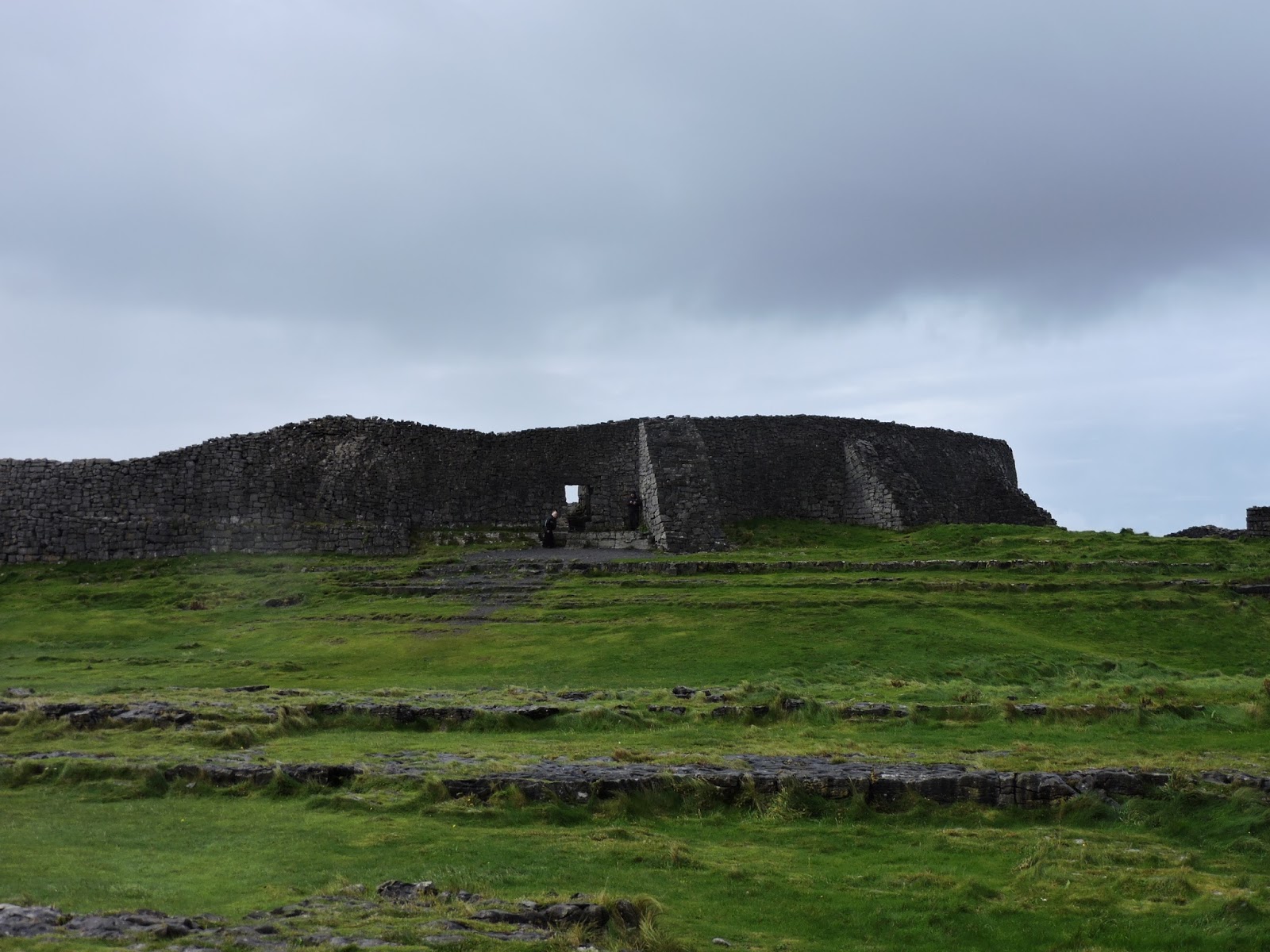
The Aran Islands are famous for many reasons, not least for the beautiful sweaters produced there which many of us came home with, but also for their beauty and the ruined fortress of Dun Aonghasa. Most of the group cycled around the largest of the Aran Islands, Inishmore, but Elizabeth and Lauren rode in a horse-drawn cart.
The day started out with the golden promise of bright sun rays, but it soon clouded and turned into a very wet day. Although we didn't know it for the first hour or so, we all would be drenched to the bone before the day's end.
It was sunny in the morning. Truly.
 We arrived at the Ferry, climbed out of the bus and promptly realized that with the sun steadily disappearing, the coastal wind (not a breeze. WIND) was freezing.
Our ferry.
 The land was getting farther away on the horizon.
 We finally did arrive at the Aran Islands and climbed into our horse drawn cart or bikes. We were already cold, and it hadn't even started raining.

The west of Ireland is mostly boggy or rocky terrain. Neither makes for good farm land, but since the Irish were forced to live there, they had to get all the rock out of the land they were trying to cultivate. This is mostly the reason for the thousands of stone walls throughout the west and on the Aran Islands. As they dragged the rocks out of the field so they could plant it, they built stone walls around the field.
We're not kidding. Stone walls are in abundance here.
 When we reached the other side of the island, we hiked up to an old bronze and iron age fort on the cliffs called Dun Aonghasa. Unfortunately, Lauren and Elizabeth started up the hill a few minutes before it started raining. As they climbed it started coming down in sheets of water and the wind gusts were so strong, they were nearly knocked off their feet. The rain stung their faces and ran down in rivers. Our jeans and coats were quickly soaked, but they decided to continue since it was pointless to turn back seeing how they were already soaked. When they got to the top, the rain was mostly stopped allowing them to briefly enjoy the area and get a view of the lovely cliffs which don't get the attention they deserve.

Since it was so miserable when they reached the top, they didn't look over the cliff edge, but when the rest of the group reached Dun Aonghasa, we crawled out on our stomachs and peeked over the edge to see the waves crashing below.
Dun Aonghasa

Dun Aonghasa was seen as a great and powerful fort because of its location. Since it is built on the top of a hill along the edge of a cliff, it has a great defensive and offensive advantage. It is high enough that it would be impossible to attack with a surprise raid. Since it is built on a cliff rather than near the shore, it cannot be attacked from the sea either. The fort Dun Aonghasa was very large and oppressive, enemies would be intimidated by its grandness. The strength and size of the fort would inspire the people and show them the strength of their leader. 

The bronze and jewelry excavated at Dun Aonghasa suggest that the residents were of high class. Among the dig, they discovered that the population living inside the fort itself was only a small percentage. The lands would have been covered with fields and livestock. Because of the harsh landscape, the livestock were small, and there would have been only a small number of pigs. The fort thrived and was economically separated, for the most part, from the mainland, giving the Islands a remote and independent political power role.

Soaked and longing for a warm fireplace, we hiked back down and did some shopping before climbing back into our cart and bikes. Elizabeth and Lauren's driver's name was Martin, and his horse was named Hopper.
Hopper has one blue eye and one brown one.
 Martian also directed Elizabeth and Lauren to an old church. It was neat getting to travel with him because he gave them a lot of interesting insights on the Aran Island and showed them old buildings like these which most people would pass by.


 Even the trip back for the girls started out pretty well, but the weather didn't hold long. The rain steadily drenched them for most of the ride back. Although Martin gave them blankets and raincoats to help, the rain was relentless and eventually poured over into every unprotected crack and down their necks and backs. There was no shelter, so their only choice was to push on.
Every landscape is improved when viewed between the ears of a horse.
 They finally arrived -- drenched and freezing, but quite happy.
They said goodbye to Hopper and Martian, got some hot chocolate and huddled up in a Pub until our ferry arrived. They never really got warm, just slightly less chilled.

As Elizabeth and Lauren were getting warmed up, the rest of the group was still trapped in the soaking rain. After visiting  Dun Aonghasa, they traveled down the island to the Worm Hole.
 Here is Eva's account of the Worm Hole:

The Worm Hole is a natural rectangular pool located on the lower cliff, east of Dun Aonghasa. To reach the Worm Hole, we biked through town and meandered through a beaten road between houses. After dropping our bikes off at a gate, we walked for a good twenty minutes or so. We jumped across large rocks and skipped over pointed edges. Following the red arrows across the rock field, we finally reached the edge of the cliff. From there we had to be careful as we walked across the slick rock for ten more minutes. Finally, we came around a corner and saw the Worm Hole. It was larger than I imagined and the scene of waves crashing against the cliff and spilling into the Worm Hole was incredible. The weather was rainy and cold, but I have heard stories of people jumping in for a quick dip. The group walked around for a bit, taking pictures and taking in the beauty of waves crashing. I have never experienced waves in such a majestic way. If you are on the cliff and walk inward, away from the water, there is a bit of an overhang from the cliff above. As the rain came down, we crawled back in that cove and looked out to the Worm Hole and then the ocean as well.  Although the Worm Hole was incredible to see, we needed to get back to catch our ferry. We traveled back through the cliffs and rock field, hopped on our bikes and headed to the harbor. I am sure glad I chose to see the Worm Hole. I think it is greater than the title makes it sound.


Of course, as we were leaving the Island the sun came out.


 After the hour long ferry ride, we got into our coach and had another hour long ride back to Galway city. We learned that we were late for our reservation at Roberta's a fancy Italian restaurant, and we would be going directly there.
By the time we arrived in Galway, we were just starting to get warmer, but then we stepped out into that coastal wind again and walked a block to arrive at the restaurant, shivering again. It was a humorous sight. We were sitting at candlelit tables, soaking wet and looking like bedraggled street rats. Diana ordered us all hot tea, and we soon got a hot meal, and once we got back to the hostel, we were able to dry off and get warmed up.

This is a video Brad made documenting our entire trip to Galway.


Clonmacnoise

  
 This is a post which Brad wrote for our academic blog about our trip to Clonmacnoise. This blog contains the adventures of Brad, Meghann, Elizabeth, and Eva.

~~~~~~~~~~~~~~~~~~~~~~~~~~~~~~~~~~~~~~~~~~~~~~~~~~~~~~~~~~~~~~~~~~~~~~~~~~

Clonmacnoise is one of the most famous monasteries in Ireland, and also one of the best-kept ruins. It was founded in the 6th century by a guy named Saint Ciaran. Clonmacnoise was one of the most important monasteries of its day, but as years went on, it became less and less relevant. One of the main reasons it was so important was because of its location. The monastery is situated right on the border of the ancient provinces of Meath and Connacht. It is because of this placement between these two kingdoms that it gained the support of the kings of both of them. 

Not only is the location good in this aspect, but it is also built right alongside the most popular highway of its day. This is not a highway that we think of today, but it is a river. Clonmacnoise is settled right on the banks of the River Shannon which was the most important north-south trade route of its day. On the other side of the monastery, perpendicular to the river, there is also a large esker that was formed after the last ice age. This was a large hill which provided safe ground amid the surrounding bogs. It acted as a highway from Dublin to Galway. Because Clonmacnoise was located at the intersection of these two main "highways," it was a particularly important monastery.


One odd thing about this monastery is the height of the round tower. Every monastery in Ireland has some kind of tall, round tower in the compound. The round tower at Clonmacnoise is one of the best-kept ruins of all the round towers in Ireland, except that it is missing the pointed cap. The thing about this round tower is that it is not very tall. For most monasteries, the more important it is, the taller the tower will be. All historians agree that Clonmacnoise was a very important monastery, but they do not know why their round tower is not nearly as tall as other monasteries (only about half the height of the tallest round tower in Ireland). One idea of why this one is so short is that in the past, the top half had been broken off in a storm and rebuilt as another small round tower separate from the original. This is only an idea, but would explain why the round tower is very small for how important this monastery was.
The round tower


Many people thought that round towers were used as lookout tower or a place of refuge during attacks, but is not the case. It originally had a bell in the cap point that they used as a bell tower for the community. One thing that is very noticeable on all round towers around Ireland is how the door always a couple of meters off the ground. This is because the round towers did not have a deep base structure underneath and the first couple meters above the ground are the structure that gives the tower strength. The door can not start until above the base or else that would take away from the strength it needed. 

The second, smaller round tower.

Another big part of the Clonmacnoise monastery are the high crosses. The entire grounds of the monastery is filled with stones crosses marking burial places, but three of these stone crosses are much bigger and noticeable than the rest. That is because these high crosses are not tombstones to represent where people are buried. In all of Ireland, there are 70 high crosses left in existence. Three of which are at Clonmacnoise. At one point in time, there was one more high cross at Clonmacnoise, but that one was not preserved. These four high crosses would have made a square around the main cathedral in the monastery and would be the border for the holiest part of the compound. 


The three high crosses that are still intact are now inside the exhibit building at Clonmacnoise the keep them safe from outdoor elements. There are three exact replicas of these high crosses in the place of the originals surrounding the cathedral. When they excavated the original high crosses to bring them indoors, they found deep holes filled with sand underneath the stone base. This lead historians to believe the stone crosses were replacements for wooden crosses that were originally placed in the four corners around that cathedral. Obviously, the wood has disintegrated over the years, but the deep holes give evidence for them. 

The most popular high cross is this pictorial one called the Cross of the Scriptures. It has scenes from the Bible carved into each face. This likely would have been used by the monks as a way to teach the scriptures.
The Cross of the Scriptures
 The South cross was carved with Celtic designs and symbols and is probably older than the Cross of the Scriptures.
The South Cross
 The oldest of them all is the North cross. This one only has the shaft of the cross left.
The North Cross

These stone crosses have no paint on them today, but it is believed that they were painted when they were originally built. There are other similar high crosses around Europe that still have residence of paint on them and historians believe that the high crosses at Clonmacnoise would be the same. The bright colors painted on the cross would make them a main point of the entire monastery. Not only were the painted, but they are also engraved with pictures. These engravings have been worn down a lot over the years, but you can still make out what they originally were. Some of the pictures are quite obvious about what they depict, such as the crucifixion scene, but others are left up to debate as they are not as obvious a scene from the Bible. 


One other cool thing at Clonmacnoise is the whispering arch that leads into the cathedral that one person can whisper into one side of the arch, and someone with their ear to the other side can hear them. Some believe that this is an old version of a confession box used by Catholics today, but this is only a far fetched theory. 
The whispering arch

The cathedral


There is also a cemetery on the outside of the Clonmacnoise monastery. Every plot in it has already been purchased. Many people believed that being burned in the monastery grounds was a free pass to heaven, and they would pay a lot of money to get in there. Once the monastery area was closed to burial, they started another cemetery right outside that people still pay to be buried there in hope to get a free pass into heaven. 
The cemetery on the Clonmacnoise grounds and the new one beyond.
Here is a video Brad made documenting our entire trip to Galway.